Chewino
Gummy Bears & Classic Shapes

The Chewiest Homemade Gummy Bears You’ll Ever Make (Ratio Included)

Chew comes down to weights, and this one runs ten parts juice to nine parts sugars to two parts gelatin. Three days on a wire rack does the rest.

Save
25 minutes activeActive time
75 minutes set, then 3 days curedSet time
About 90 bearsMakes
GelatinBase
IntermediateLevel

Put the measuring cups away and get a scale out. Every number below is a weight, and chew is a question of how those weights sit against one another. Miss one of them by ten grams and you find out three days later, when it is far too late to do anything about it. Chewy pushes back and then gives way. Rubbery squeaks against the teeth and never quite breaks down.

Underneath this recipe sits a ratio of ten to nine to two, by weight. Ten of juice, nine of sugars, two of gelatin. In one batch that lands at 150 g of juice and 30 g of gelatin, with 135 g of sugar and glucose syrup sitting between them. Scale the whole block up or down and it behaves the same way.

Gelatin alone will not get you there. Half the texture arrives after the mould, over three days on a wire rack, while water leaves and what stays behind packs tighter. Skip that part and you have a soft bear made from a chewy recipe.

What you need

  • 150 g cold fruit juice (grape or tart cherry both give real colour)
  • 90 g granulated sugar
  • 45 g glucose syrup, or light corn syrup
  • 30 g powdered gelatin, 200 to 225 bloom
  • 3 g citric acid, optional, for a tart finish
  • A few drops of neutral oil for the mould
  • Silicone bear mould, cavities around 3 ml
  • Wire cooling rack

Method

  1. 1Weigh 60 g of the cold juice into a small bowl. Scatter the gelatin over the surface, stir once, then leave it ten minutes. It should go stiff and look like wet sand.
  2. 2Put your empty pan on the scale and write down what it reads. That number is what tells you when the syrup is done.
  3. 3Add the other 90 g of juice to the pan with the sugar and the glucose syrup. Warm it gently, stirring, until you cannot feel any grit on the base.
  4. 4Raise the heat to a steady simmer. Let it reduce until pan and contents together weigh 180 g more than the empty pan did, which takes six to eight minutes.
  5. 5Pull the pan off the heat and wait a minute. Add the bloomed gelatin in one lump and stir until the mixture runs clear off the spoon. It does not go back on the burner.
  6. 6Stir in the citric acid and any colour now.
  7. 7Let the pan stand two minutes, then skim the foam off the top. Foam sets into a cloudy white cap on every bear.
  8. 8Wipe the mould with a trace of oil. Pour through a squeeze bottle or a small jug with a spout, filling each cavity right to the rim.
  9. 9Leave the mould at room temperature for 45 minutes, then move it to the fridge for another 30. Cold makes them release without tearing an ear off.
  10. 10Unmould onto the wire rack, spaced so none of them touch. Leave them three days at room temperature, turning them once a day.

What each part of the ratio is doing

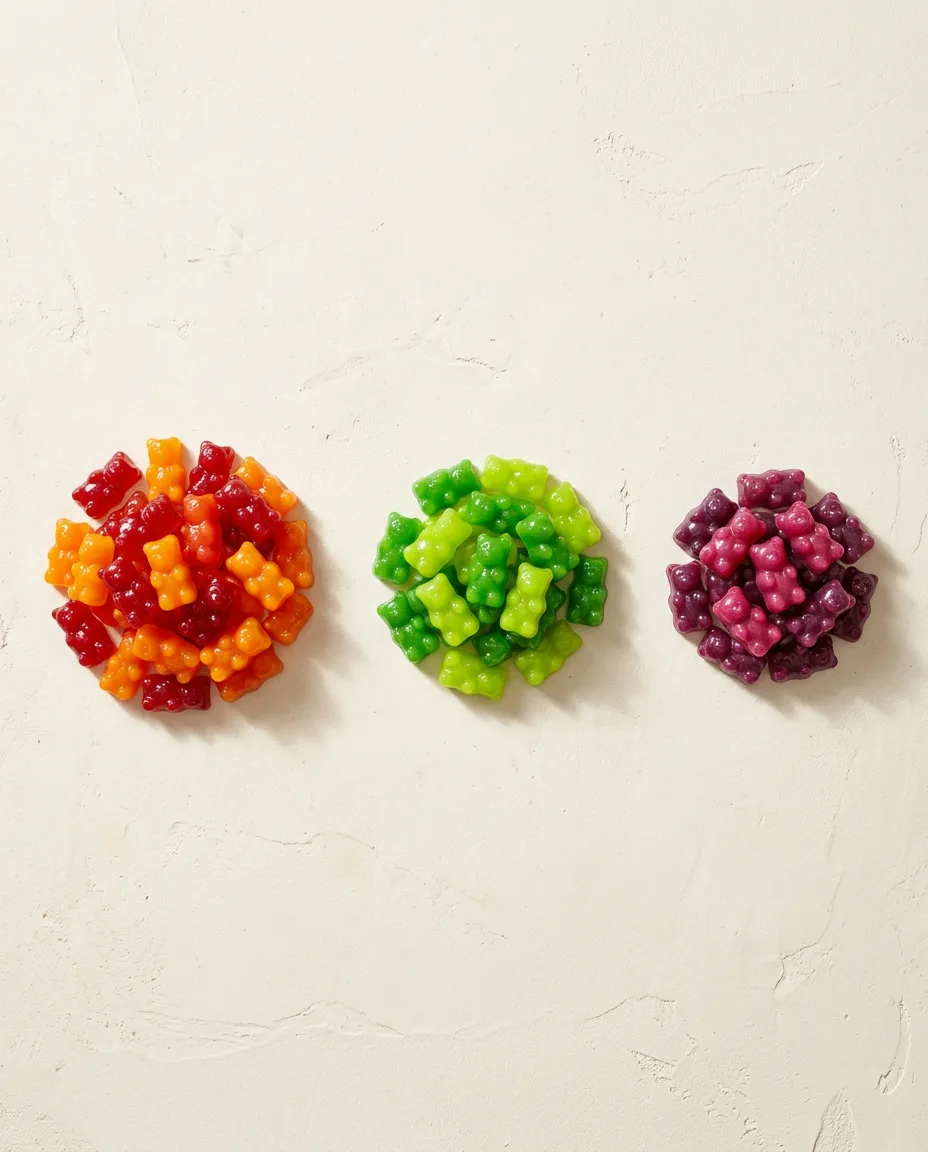
Three heaps of colourful gummy bears in graduated sizes on a pale plaster surfaceSave

Gelatin decides how hard the bear pushes back. Thirty grams against 150 g of juice is one part in five, which is a lot by any home standard and roughly double what most juice-gummy recipes ask for. Take it to one in four and the texture goes squeaky. At one in seven you get a bear that holds its ears on the shelf and then collapses the moment you bite it.

Sugar does two jobs, and sweetness is the smaller one. The 90 g of granulated sugar and 45 g of glucose syrup hold water inside the gel so the bear stays bendy rather than drying to a chip. Glucose has a second use: it stops the sugar turning grainy while the bears sit out. Use 135 g of plain sugar instead and fine white crystals will push through the surface by day two.

Juice is the part you can change freely, so long as the weight stays at 150 g. Grape gives a purple you cannot buy in a bottle of colouring. Tart cherry lands closer to the flavour most people mean when they say gummy bear. Protease fruits are the exception, and they are not negotiable: mango, pineapple, kiwi, papaya, guava, fig. Enzymes in those fruits cut gelatin apart, and a batch made with them sits in the mould as a puddle the next morning.
Weigh the pan before you cook the syrup

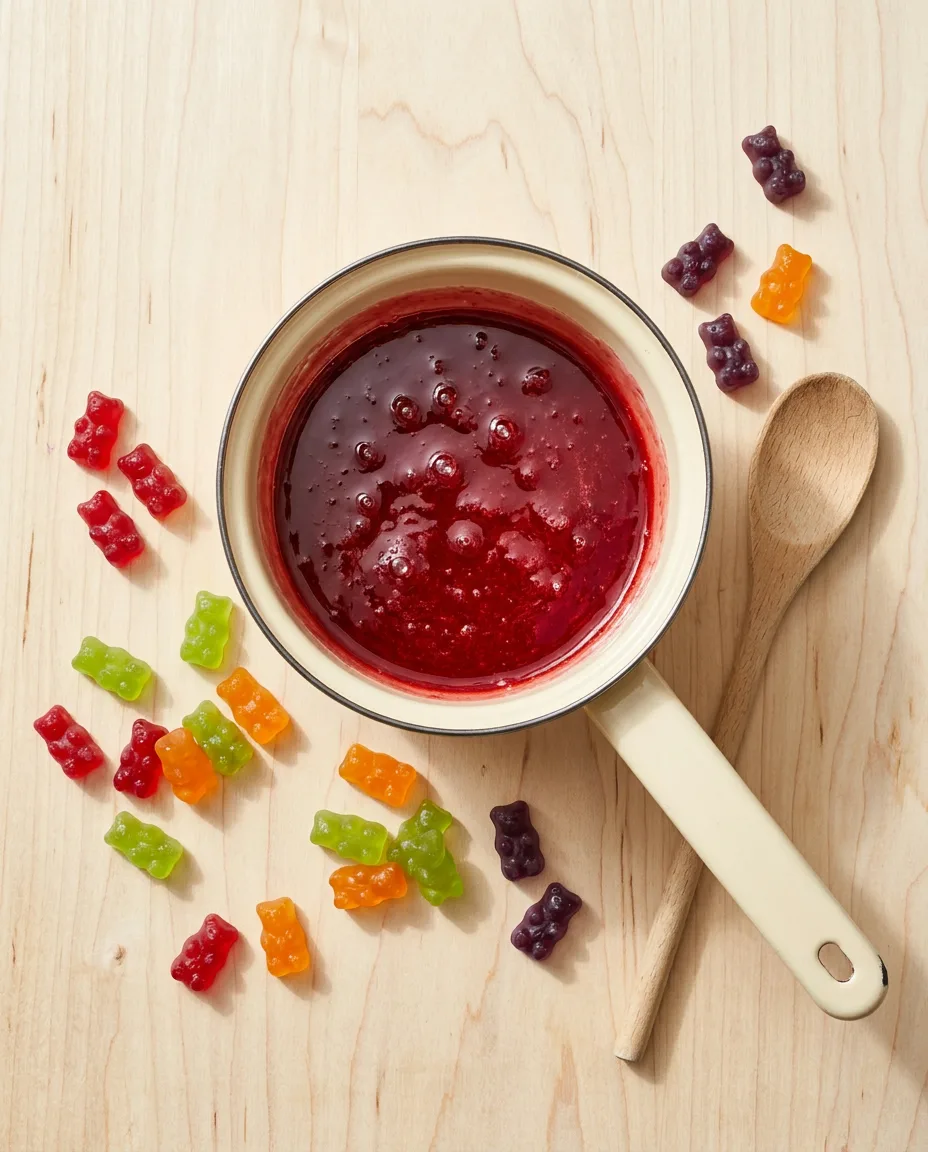
A small cream pan of deep red fruit syrup surrounded by colourful gummy bearsSave

Most gummy recipes stop at dissolving the sugar. That leaves far too much water in the pan, and water is what stands between a bear you can chew and one that dents under a thumbnail. Cooking the syrup down to a fixed weight is the single biggest change you can make to the finish.

Weighing the pan empty turns the whole step into one number. Contents go in at 225 g. You cook until the pan reads 180 g above its bare weight, which means about 45 g of water has left. No guessing at bubble size, no holding a strand up to the light. When the scale says 180, stop.

A thermometer gets you to the same place, around 108 to 110 °C, if you already own one. But 225 g of syrup in a small pan barely covers a probe tip, and the reading swings depending on where you hold it. Weight does not drift like that.

One thing the scale will not warn you about: heat still in the pan. Gelatin stirred into syrup above about 85 °C loses part of its setting strength, which is why the method parks the pan for a minute first. Rush it and you paid for 30 g of gelatin to get the performance of 25.

Day three is when the chew arrives

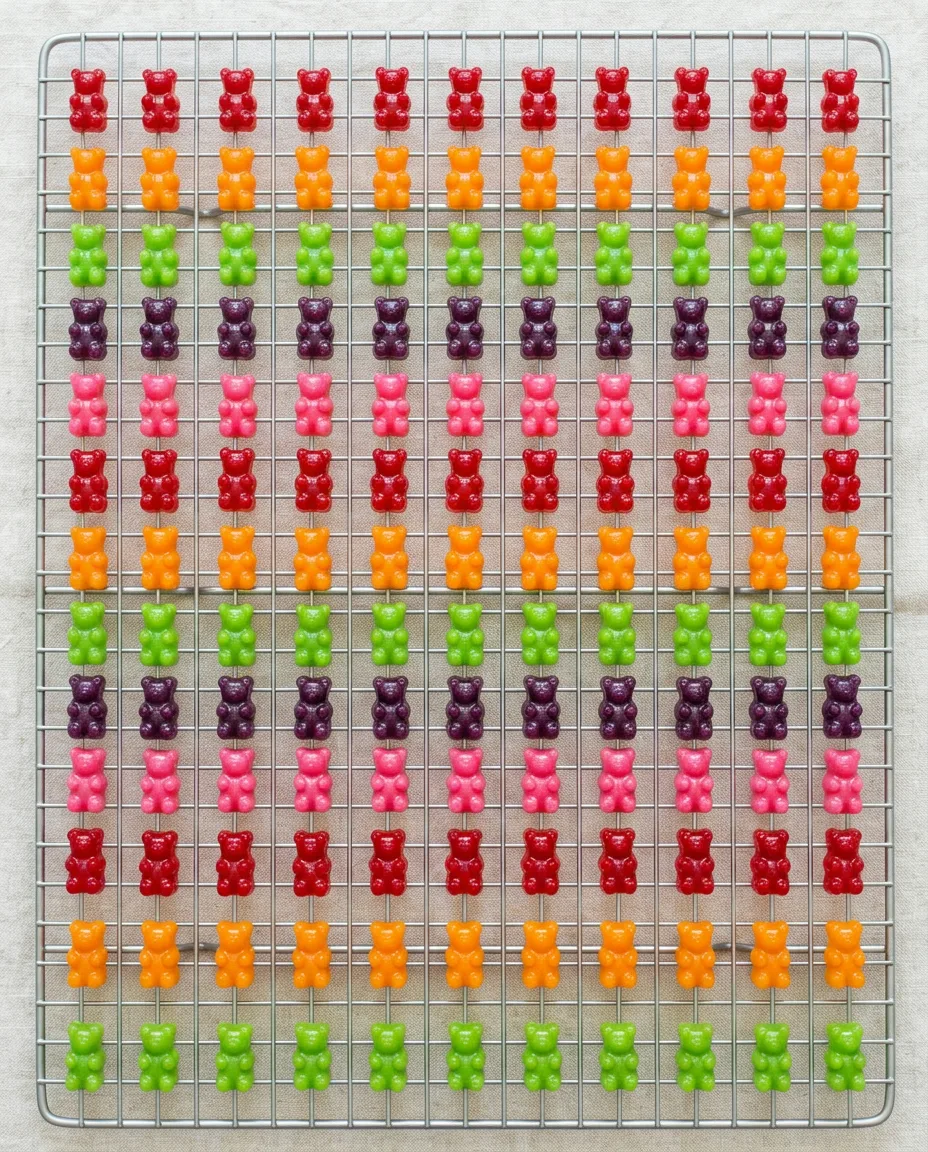
Gummy bears drying in spaced rows on a wire cooling rackSave

Straight out of the mould the bears are set but slack. They hold their shape, they taste right, and most people eat half the batch at this stage without ever finding out what the recipe was for. Curing is where the ratio cashes out.

On day one the surface is glossy and tacky to a fingertip, and a bear squashed between finger and thumb stays squashed. By day two a thin dry skin has formed and the inside has started to firm up underneath it. Day three is the one worth waiting for. The skin has gone leathery, the middle has pulled tight, and a bear now springs back instead of holding the dent. Roughly a sixth of the batch weight has walked off as water, which is exactly the point of leaving them there.

Humidity decides whether three days is enough. In a damp kitchen the same rack can still be tacky on day four. A fan set on low at the far end of the counter fixes that faster than a warmer room would. What does not work is a sealed tub, where the water leaving the bears has nowhere to go and simply returns to them overnight.

Sheet gelatin needs a different number

The 30 g assumes powdered gelatin somewhere between 200 and 225 bloom, which covers nearly every supermarket sachet. Bloom is a strength rating rather than a brand, and a higher number sets harder for the same weight. Gold sheets sit near 200 and platinum near 250. On platinum, 25 g does the work of 30.

Sheets also carry water. Soak them in plenty of cold water for five minutes, lift them out, and squeeze them properly before they go into the pan, because anything left clinging is liquid you never weighed. Going this route, put all 150 g of juice into the pan at the start and cook to 240 g above the bare pan weight instead of 180.

Powder is cheaper by the gram and far easier to weigh accurately, so switching to sheets makes sense only if sheets are what you already have in the drawer.

If they squeak, you went too far

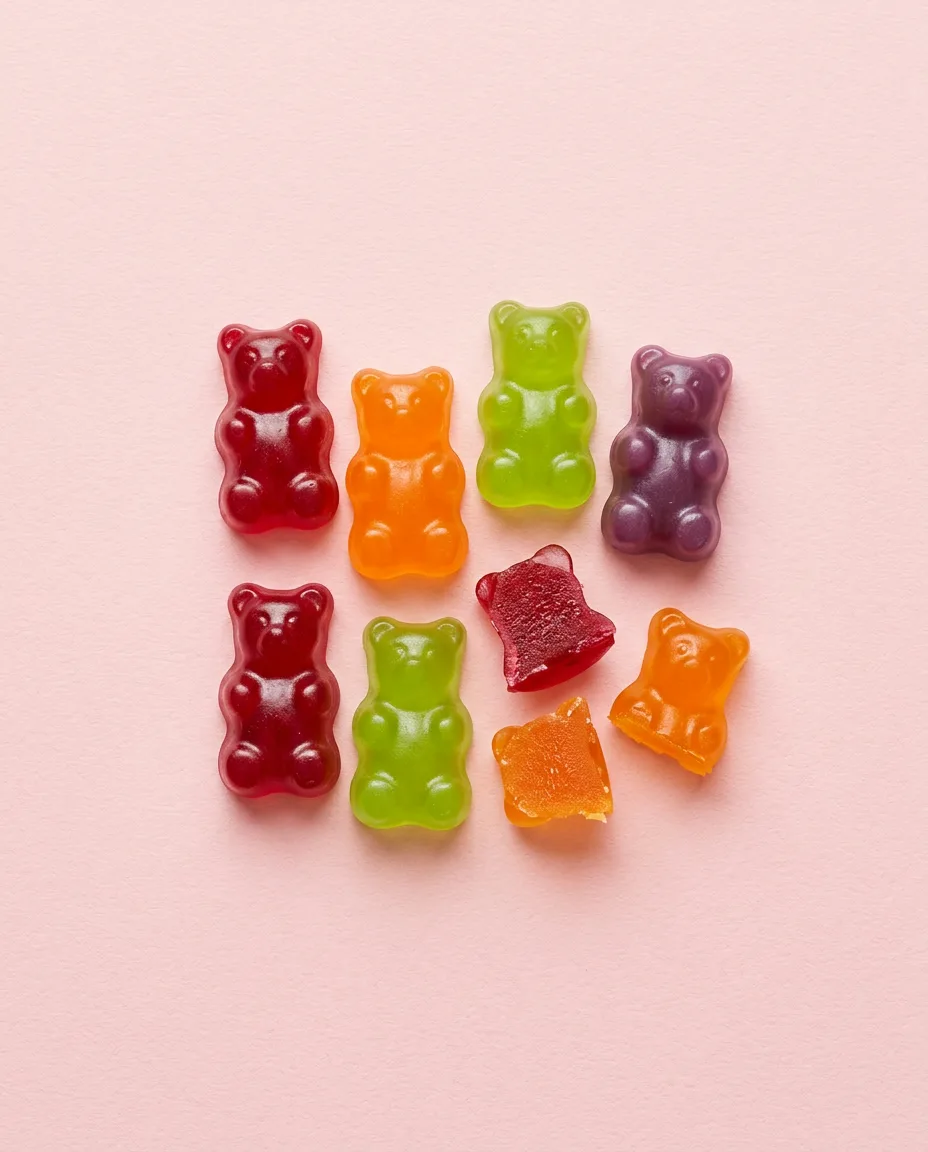
Gummy bears with two torn in half to show the dense chewy interiorSave

Squeak is the sound of too much gelatin meeting tooth enamel. A bear that has crossed the line tears rather than breaking, and the torn face comes up matte instead of glassy. Drop the gelatin to 26 g and change nothing else. That shifts you from one part in five to one in six, and the bears will still hold their ears through a warm afternoon.

Soft and sticky on day three is the opposite problem, and it almost always traces back to the pan. Put a handful of bears on the scale. A batch that went into the mould at around 270 g should come off the rack somewhere near 230 g. Sitting well above that means water is still in there, and another day on the rack costs nothing but patience.

Cloudy bears are a third, unrelated thing. That is foam you skimmed too early or not at all, or air whipped in while stirring the gelatin. Stir slowly, in one direction, and let the pan rest the full two minutes before pouring.

Shelf life is shorter than it looks

Nothing in this recipe preserves anything. Sugar and a low water content buy you time, then they stop buying it. Cured bears keep about two weeks in a lidded jar in the fridge, or about five days in a cupboard, and the cupboard version will be noticeably firmer by the end of that. Anything left going soft again has picked up moisture and should be eaten rather than stored further.

Line the jar with a paper towel for the first couple of days, in case a few bears are still giving up water. Tossing them in a little cornflour cut with citric acid keeps them from welding into one mass, and plain caster sugar does nearly as well while tasting better.

Freezing works, and it costs nothing in texture. Thaw them spread out on the rack rather than sealed in the jar, because water condensing out of the air lands on cold bears and puts you right back at tacky.