Chewino
Gummy Bears & Classic Shapes

Gummy Bears Without Corn Syrup or Dye — The Recipe That Finally Worked

Corn syrup does a specific job in a gummy bear, and taking it out without replacing that job is why the batch goes grainy. Here is the replacement, in grams.

Save
40 minutesActive time
2 hours chilled, then 24 to 48 hours curingSet time
About 120 small bearsMakes
GelatinBase
IntermediateLevel

Four days after they set, the bears go chalky. The surface dulls first. Then a white bloom creeps up from the base, and what was a proper chew turns short and crumbly.

That is sugar recrystallising. Corn syrup was the thing preventing it, and pulling it out without a replacement leaves the sugar free to line back up. Honey and maple syrup get suggested as swaps. Neither one does the same job at the same weight, and both bring a flavour of their own along with them.

Dye is a separate problem with a separate fix. A juice batch with no colouring usually lands somewhere between beige and brown, because most juice is too dilute to carry colour through 30 g of gelatin. Reducing it is what solves that.

Everything below is in grams. The ratio is what makes a bear hold its ears, and grams are the only way to hit a ratio twice.

What you need

  • 260 g tart cherry juice, not from concentrate
  • 30 g powdered gelatin, 200 bloom
  • 55 g invert sugar syrup, cooked from the recipe further down, or bought tapioca syrup
  • 40 g caster sugar
  • 1 g citric acid, or 10 g lemon juice
  • A few drops of neutral oil for the mould
  • A silicone bear mould with 2 ml cavities, and a squeeze bottle or a small jug

Method

  1. 1Simmer the cherry juice in a wide pan until it weighs 150 g. In a wide pan that takes 10 to 14 minutes. Let it cool to room temperature before anything else happens to it.
  2. 2Scatter the gelatin across the surface of the cooled reduction in a thin even layer. Leave it 10 minutes. It should end up looking like wet sand, with no dry specks left on top.
  3. 3Wipe the mould with a trace of neutral oil on kitchen paper. A trace is the whole instruction; more than that and the bears come out greasy.
  4. 4Set the bowl over a pan of water at a bare simmer. Stir slowly until the gelatin has dissolved and the mixture runs clear off the back of a spoon. Keep it under 70°C, since gelatin starts losing strength somewhere above 80°C.
  5. 5Take the bowl off the heat. Stir in the caster sugar and the invert syrup while the mixture is still warm, until no grains are left in the bottom.
  6. 6Stir in the citric acid last, with the bowl well away from the heat.
  7. 7Skim the foam off the top with a spoon and throw it away. Foam trapped in the mix is what gives you a cloudy bear.
  8. 8Fill the mould with a squeeze bottle, level with the top of each cavity rather than domed. Work quickly; the mix starts thickening once it drops under about 45°C.
  9. 9Chill for 2 hours, until a bear pops out of its cavity without stretching. Turn them onto a wire rack.
  10. 10Cure at room temperature for 24 to 48 hours before they go anywhere near a jar.

Corn syrup is there to stop crystals forming

Table sugar is sucrose, and sucrose wants to be a crystal. In a thick syrup it stays dissolved under protest. As water leaves a curing gummy, the molecules find each other again and lock into grit. Corn syrup interrupts that. It is mostly glucose in chains of different lengths, and those chains physically get in the way. Nothing can line up neatly around them.

Invert sugar does the same job from another direction. Heating sugar with a little acid splits each sucrose molecule into its two halves, glucose and fructose. Those halves are just as obstructive. Honey is already inverted, which is why a jar of honey never turns gritty on its own, and it would work here. It would also taste of honey at 55 g.

Bought tapioca syrup swaps in at the same weight with almost no flavour of its own. Brown rice syrup does too. Both cost several times what sugar and water cost. Cooking your own takes 25 minutes and yields about 380 g, which covers seven batches and keeps six months in the fridge.
Make the invert syrup a day ahead

Do not stir it once it is simmering. Stirring drags sugar crystals off the pan wall back down into the syrup, and one seed crystal is enough to turn the whole jar grainy as it cools.

Weigh 300 g caster sugar and 150 g water into a small heavy pan. Add 1 g citric acid, or 10 g lemon juice if that is what the house has. Bring it to a simmer without stirring, then hold it between 105 and 110°C for 20 minutes. Brush the inside wall of the pan down with a wet pastry brush every few minutes. That washes stray crystals back in before they can seed anything.

It is ready when a drop cooled on a cold plate is thick like warm honey and still clear. Pour it into a clean jar while it is hot. Cold invert syrup does not want to leave a pan.

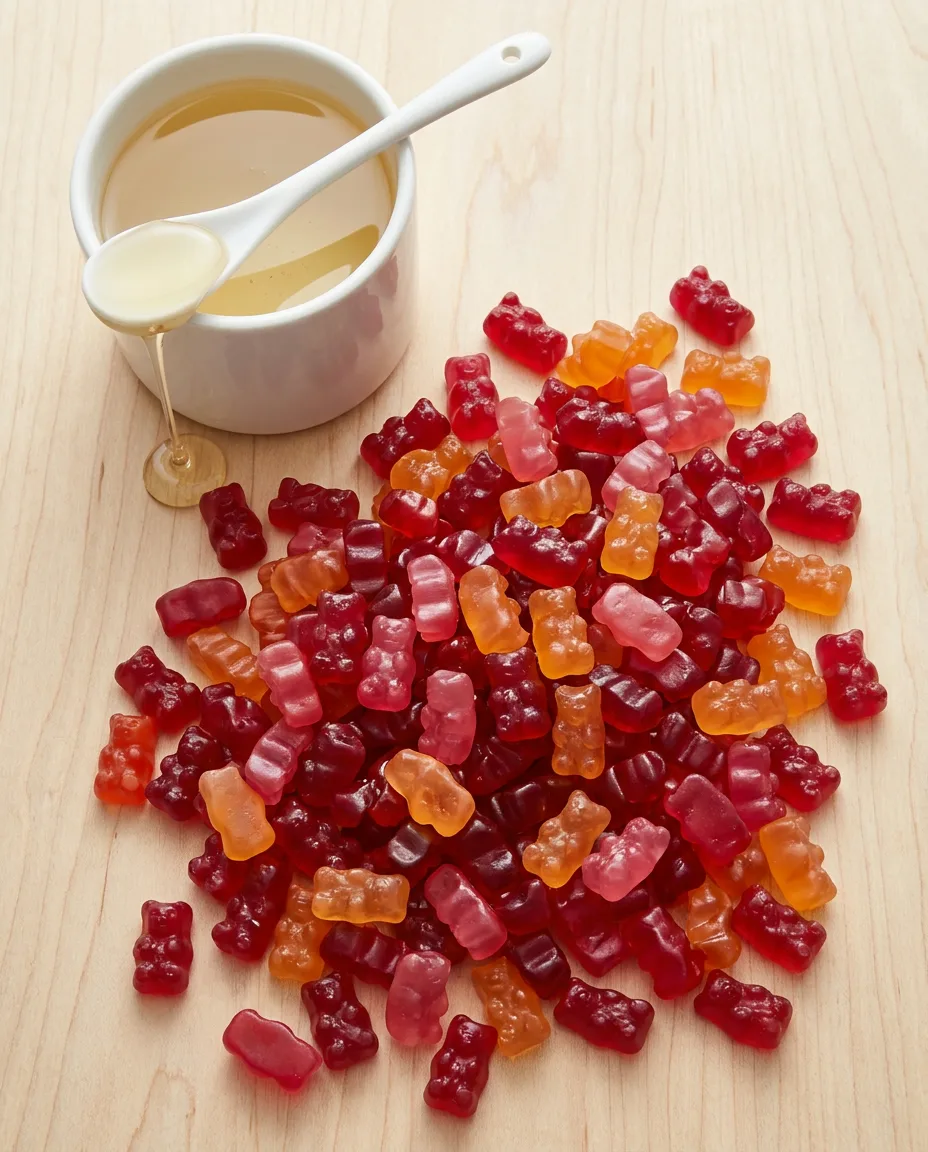
A small white pot of pale golden invert sugar syrup beside a heap of red and pink gummy bearsSave

Colour comes out of the juice, so reduce it hard

260 g of tart cherry juice down to 150 g is a 42 percent loss of water. The colour concentrates by the same amount. That reduction looks too dark in the pan, which is roughly right, because 30 g of pale gelatin is about to dilute it.

Red and purple fruit colours come from anthocyanins, a group of pigments that shift shade with acidity. More acid pushes them red. Less acid pushes them towards grey and blue. Long heat dulls them whatever the acidity is doing, which is why the citric acid goes in at the very end and the reduction gets the shortest boil that will do the job.

Other colours are available and every one of them is duller than dye. 2 g of beetroot powder gives a clean pink that visibly fades inside a week. 3 g of freeze-dried raspberry powder holds on longer. Turmeric at 0.5 g gives yellow; at 1 g it gives yellow plus a taste of turmeric. Spirulina makes a green that also tastes of spirulina, so stay under 1 g. Blue is not happening without butterfly pea flower, and butterfly pea turns pink the second the citric acid lands on it.

Pick two colours for a batch. Each one needs its own pan of reduction, and the first bowl is setting while you are still dividing up the second.

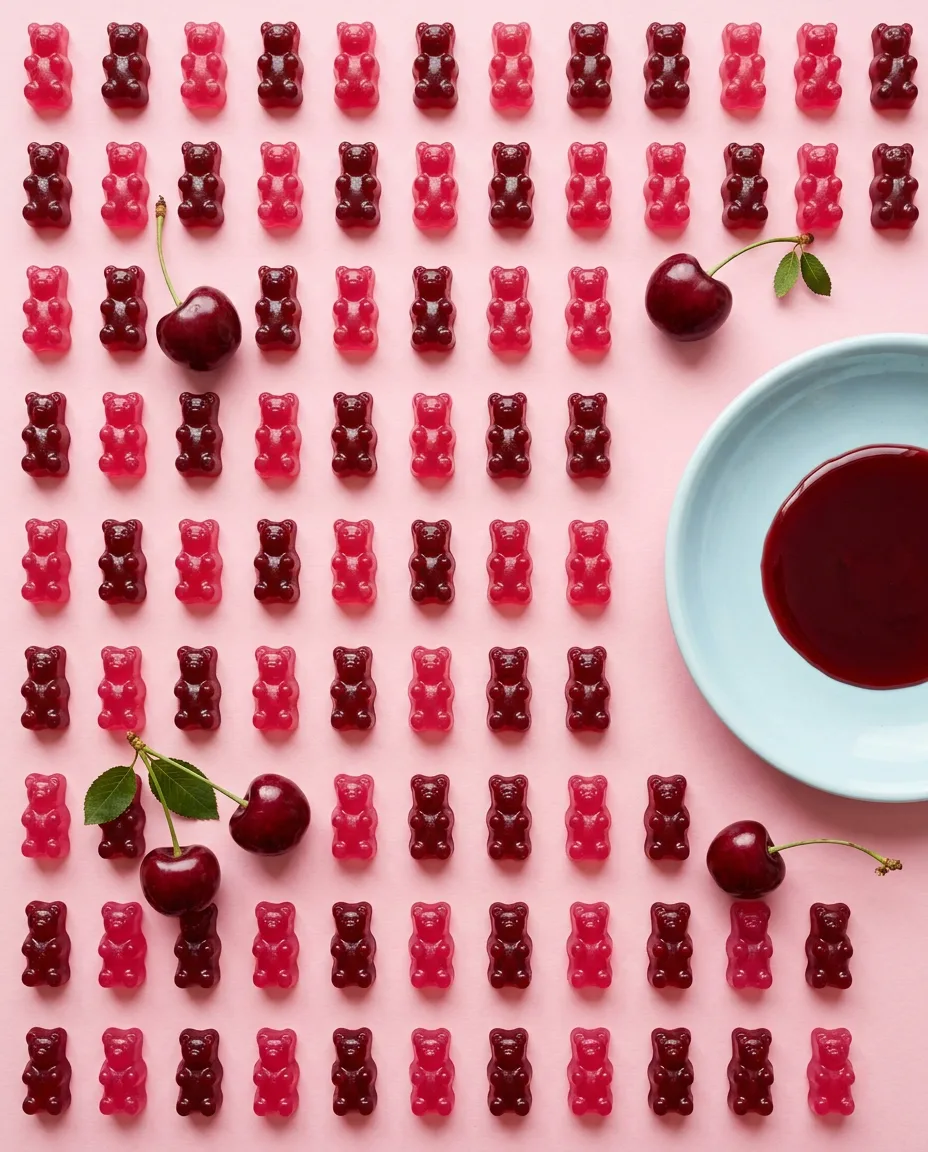
A shallow dish of thick reduced cherry juice beside rows of deep red gummy bears and fresh cherriesSave

Fifteen percent gelatin, give or take a point

30 g of gelatin to 205 g of liquid works out at about 15 percent. The liquid there is the 150 g reduction plus the 55 g of syrup. Use 200 bloom powder, bloom being a strength rating, and 200 is what most supermarket sachets are.

Under roughly 12 percent the mix still sets, but the bear sags. Ears round off overnight and the feet spread out. Over 18 percent it turns rubbery, and a rubbery gummy takes a hard bite and then springs straight back at you. The window between those numbers is wider than it sounds, so anywhere from 14 to 16 percent is comfortable.

Scatter the powder across the cold reduction rather than tipping it in. A dumped heap forms a lump with a dry core, that core never dissolves, and it finishes up as a gritty speck inside a finished bear. Ten minutes of blooming is plenty at this ratio.

And leaf gelatin works, if leaf is what you have. 30 g of powder is about 17 gold-strength leaves at 1.7 g each. Soak them in plenty of cold water, then squeeze them out hard, because whatever water they carry in thins the reduction you just spent 12 minutes making.

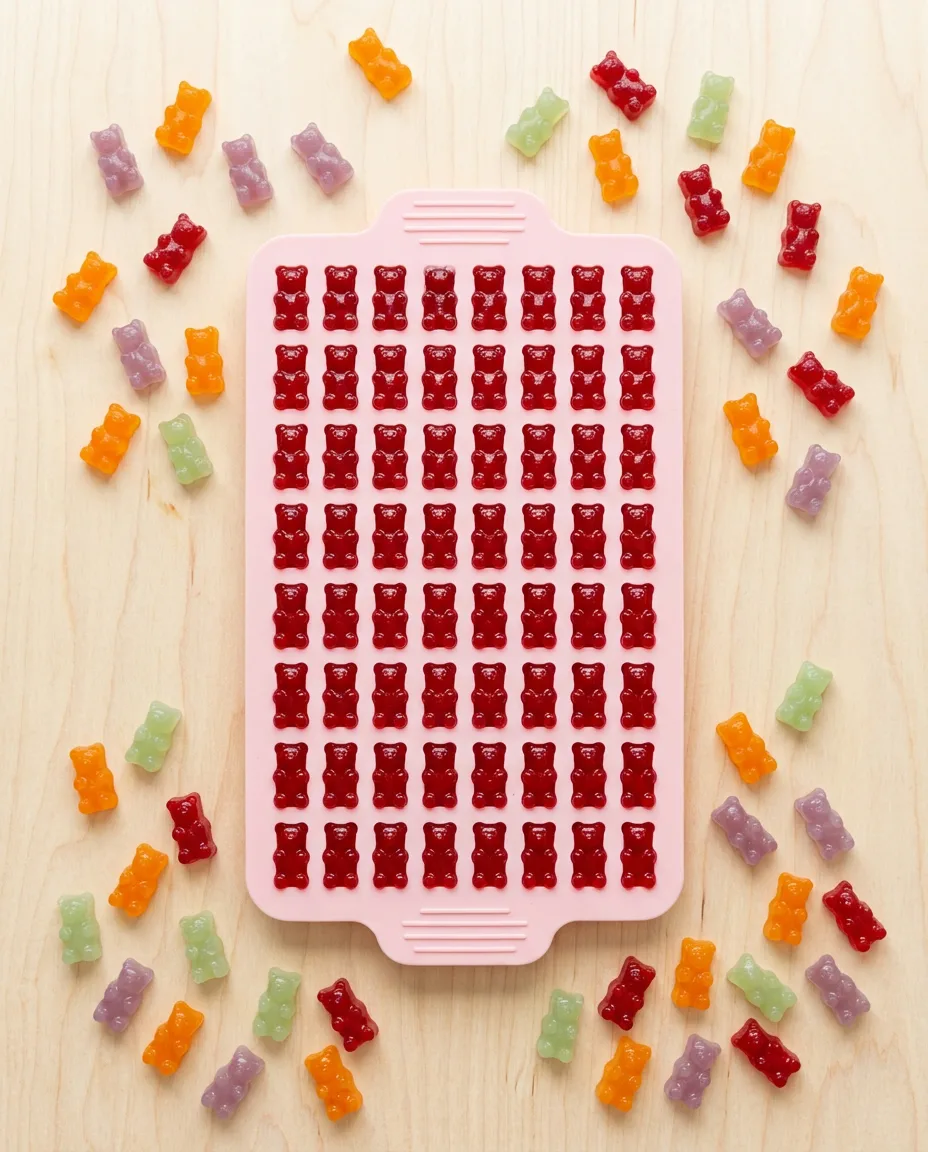
A silicone bear mould filled level with red gummy mixture, finished coloured bears scattered around itSave

Curing is the step that decides the surface

Straight out of the mould a bear holds around 22 percent water. A shop-made one sits nearer 15. That gap is the whole difference between something soft and wobbly and something that chews.

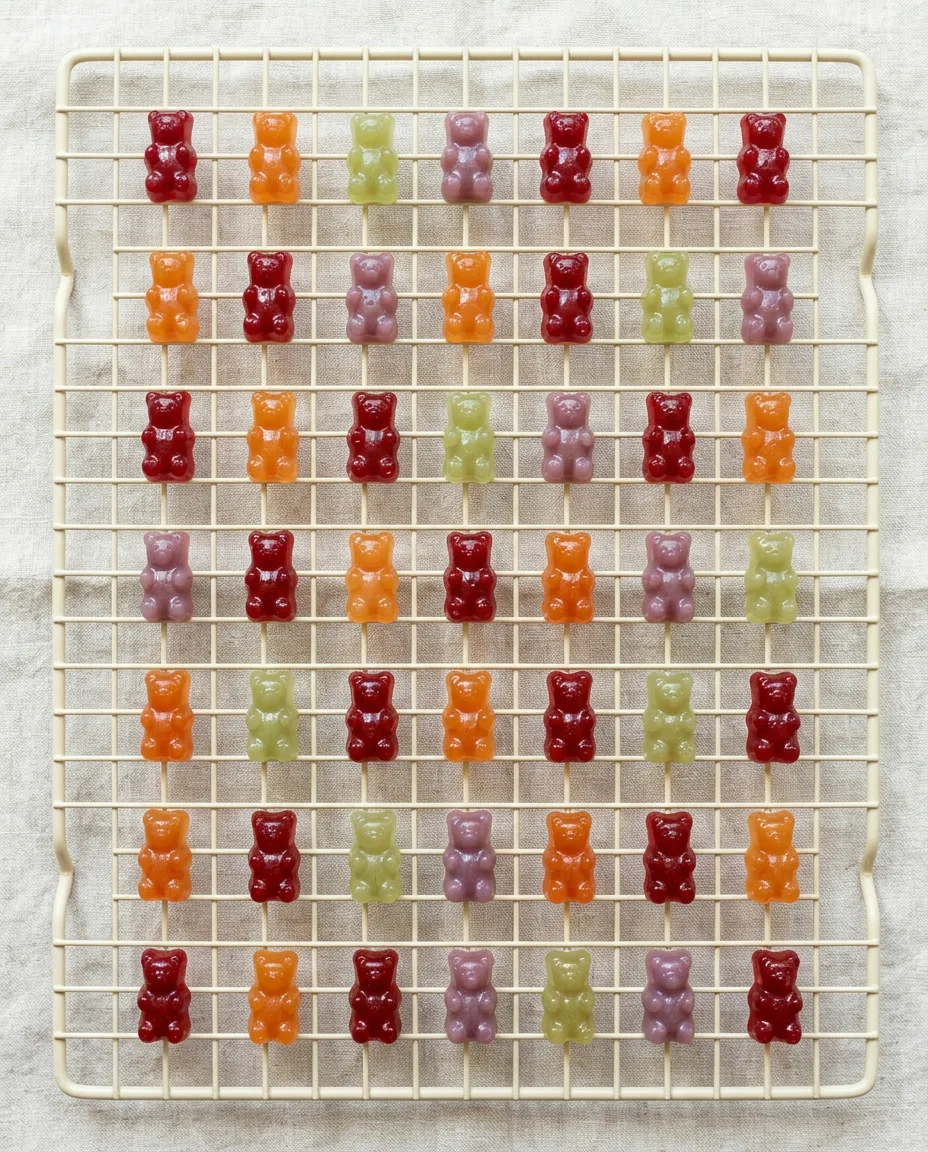
Space them out on a wire rack at room temperature for 24 to 48 hours, turning them once on the second day. The fridge is the wrong place for this part. Fridge air is damp, and a damp bear never loses the water it has to lose.

Humidity in the room decides how long it takes. Above about 60 percent they stop drying and go tacky instead. A small fan aimed past the rack fixes that faster than extra hours will. An airing cupboard is too warm; they slump, and the ears go first. Cool and dry beats warm and dry here.

A sour coating is optional, and it goes on after curing. Mix caster sugar and citric acid at 1:1 by weight, then toss the cured bears through it a handful at a time. Coat one that is still damp and the sugar dissolves into syrup on contact.

Coloured gummy bears spaced out in rows on a pale wire rack to cureSave

Two weeks in the fridge, and that is the honest number

There is no preservative in this and no control over water activity, which is the measure of how much free water a microbe can get at. In an airtight jar in the fridge, two to three weeks. On a shelf at room temperature, about five days before the surface turns tacky.

Mould shows up as fuzzy white or grey spots, and it starts where two bears were touching. One spotted bear means the jar goes out, not just the bear. Freezing is no way around any of it, since they come back grainy from the thaw.

Make the full 120 and get through them inside a fortnight. If that sounds like a lot of bear, halve every number on the list; the ratio survives being cut in half, and 60 bears is about a week.