Chewino
Gummy Bears & Classic Shapes

Strawberry Gummy Bears From Actual Strawberries, Not Flavoring

A strawberry is 91 percent water. Boil 500 g of them down to 150 g of purée before the gelatin goes in, and 25 g of gelatin is all the batch needs.

Save
Strawberry Gummy Bears From Actual Strawberries, Not Flavoring
35 minutes activeActive time
25 minutes chilled, then 24 to 72 hours curedSet time
About 150 bears, roughly 2 g eachMakes
GelatinBase
IntermediateLevel

Strawberry flavouring makes a decent bear. Real strawberries make a better one, and the difference lands in the finish rather than in the first bite. Flavouring hits hard and then disappears. Fruit stays. What the fruit costs you is water, because a strawberry is about 91 percent water, and water is the one thing a gummy bear cannot carry much of.

Twenty of the thirty-five minutes of working time go on removing water, before the gelatin gets anywhere near the pan. Five hundred grams of strawberries in. One hundred and fifty grams of thick red purée out. That purée is what separates a bear tasting of strawberry from one tasting of pink sugar.

What you need

  • 500 g strawberries, hulled (fresh or frozen both work)
  • 45 g caster sugar
  • 25 g glucose syrup, or light corn syrup
  • 25 g powdered gelatin, 200 bloom or higher (bloom is the firmness grade printed on the box, and a higher number sets harder)
  • 90 g cold water, for soaking the gelatin
  • 5 g lemon juice, about a teaspoon
  • A little neutral oil for the mould
  • 1 g citric acid, optional, for a sour finish

Method

  1. 1Blitz the hulled strawberries to a purée, then push it through a fine sieve. The seeds never soften and they make a gritty bear.
  2. 2Tip the strained purée into a wide pan with the sugar and the glucose syrup. Weigh the empty pan first and write the number down.
  3. 3Simmer over medium heat, stirring often, until the pan and its contents weigh 150 g more than the empty pan did. Twenty minutes or so in a wide pan.
  4. 4Stir in the lemon juice, take the pan off the heat, and let the purée fall to 60°C. Gelatin starts losing strength above about 70°C, so the wait is doing real work.
  5. 5While it cools, scatter the gelatin over the 90 g of cold water. Scatter rather than dump. A clump seals its own surface and never wets through. Leave it ten minutes, until it swells into a firm rubbery block.
  6. 6Stir the soaked gelatin into the warm purée until no lumps are left. Nothing goes back on the heat after this.
  7. 7Skim the foam off the surface. Foam that gets stirred back in shows up later as cloudy white streaks inside the bears.
  8. 8Wipe the mould with a trace of oil, fill each cavity with the dropper, then scrape the top flat with a card.
  9. 9Chill 25 minutes, then demould onto a wire rack.

Strawberries are mostly water, and that is the whole problem

Cut one open and you are looking at roughly nine parts water to one part everything else. The everything else is the flavour. Boil the water off and what remains gets louder, which is why reduced purée tastes several times stronger than the fruit it came from. Take 500 g of hulled berries down to 150 g and you have dropped 70 percent of the weight, nearly all of it water.

Skip that step and the arithmetic turns against you. Thin purée means more liquid in the pan. More liquid means more gelatin to set it. More gelatin brings a flat savoury note into the finished bear, and people usually blame that on the fruit. Reducing first is what lets the recipe hold at a sane 25 g. Batches that skip it come out pale orange and soft through the middle, then weep in the tub by the second day.

There is good news specific to this fruit. Strawberries do not attack gelatin. Pineapple and kiwi carry enzymes that cut gelatin protein apart, and a gelatin gummy built on either one stays liquid forever. Strawberry has nothing like that. Gelatin sets in it cleanly, so you can use the base that actually chews instead of reaching for agar.
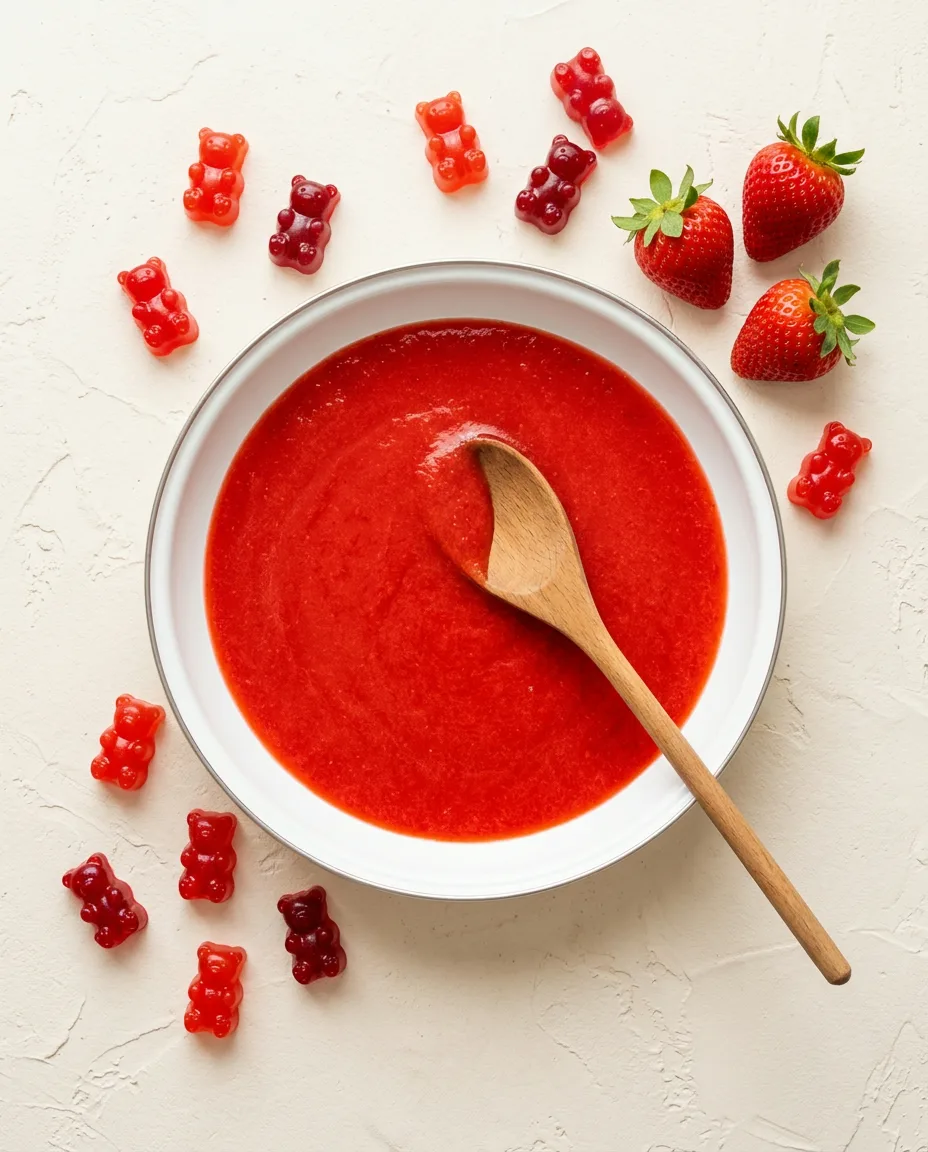
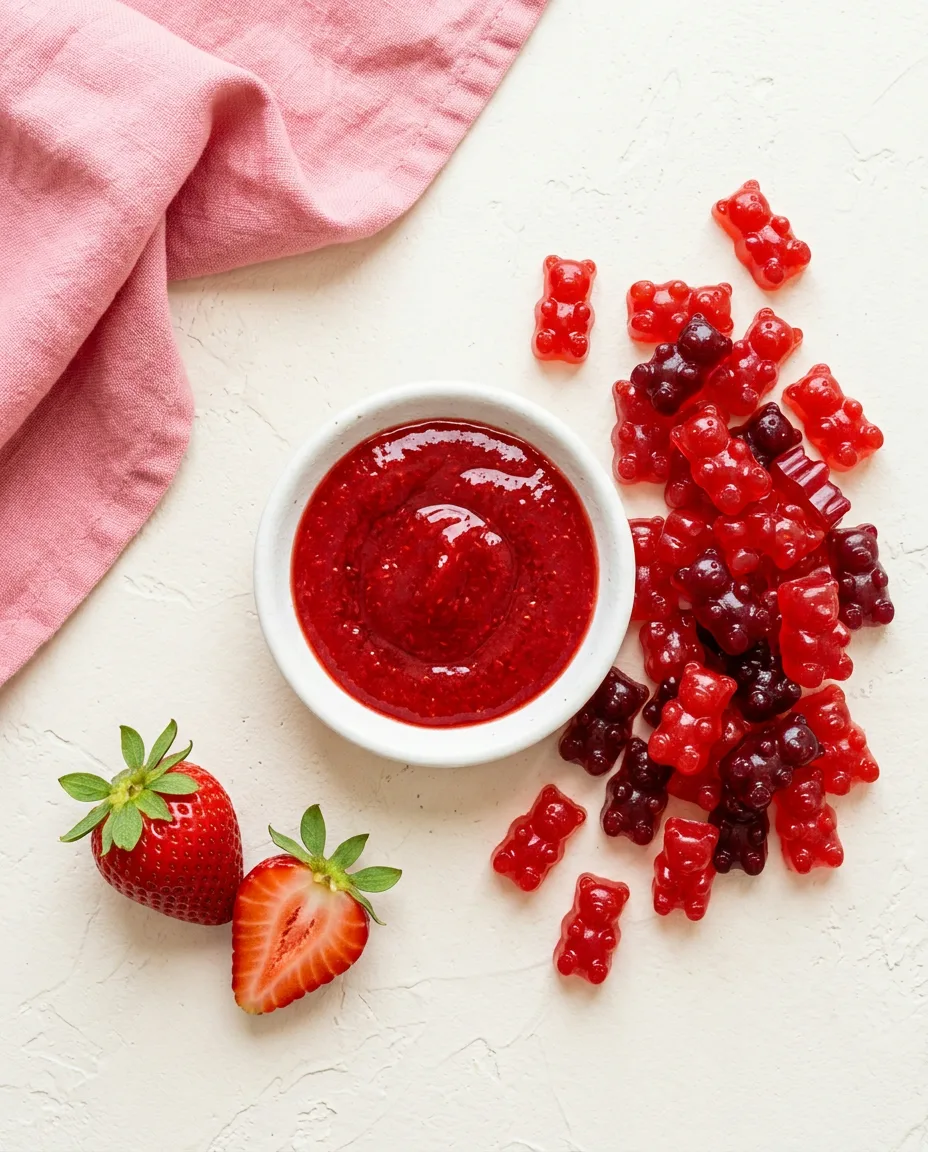
A white dish of thick red strawberry puree beside a pile of finished strawberry-red gummy bears and fresh strawberriesSave

What you need

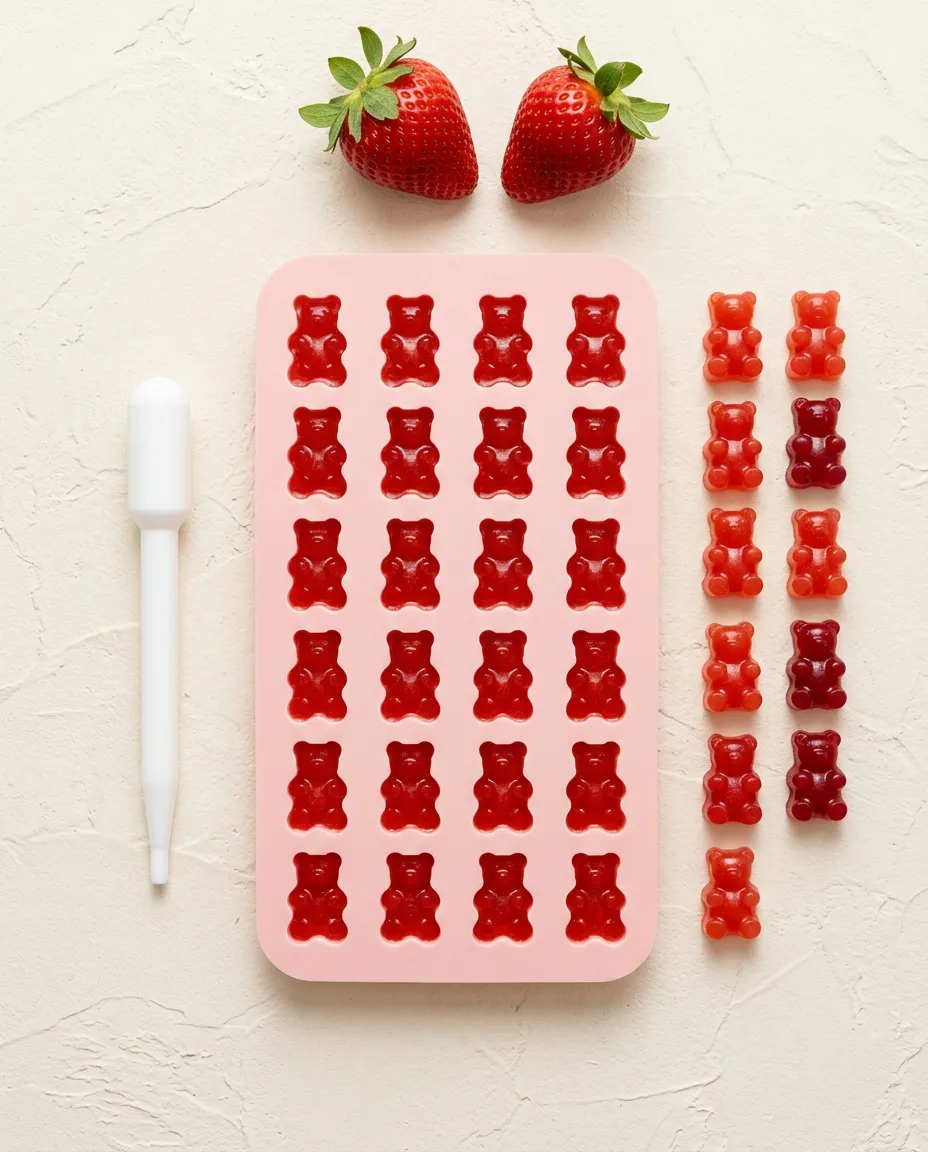
You need a fine sieve and a silicone bear mould. A squeeze bottle or a plastic dropper fills the cavities far more neatly than a spoon, and neatness decides whether the bears end up with faces. Use a wide pan rather than a tall saucepan for the reduction. Surface area is what moves water, and a wide pan roughly halves the time.

Make the bears

A pink silicone bear mould with cavities filled with red gummy mixture and finished bears standing alongsideSave

Brown purée is a heat problem

The red in a strawberry is anthocyanin, the same family of pigment that colours blackberries and red cabbage. It is not stable. Long heat breaks it into brownish compounds, and it fades faster as acidity drops. A purée that went into the pan bright can come out the colour of tomato paste, and nothing you add later hides that.

Cook fast in a wide pan rather than slowly in a deep one. The pigment is counting minutes at temperature, not degrees. Keep the lemon juice in the recipe too, because those 5 g are there for colour as much as for taste, and going without costs you a visible shade. Reduce in stainless or enamel while you are at it. A bare aluminium or cast-iron pan hands the pigment metal ions to bind with and the purée greys.

Frozen berries often give better colour than out-of-season fresh ones, since they were picked ripe rather than picked hard. But they give up their water faster once the pan is hot. Take a few minutes off the reduction and start weighing early.

A wide white enamel pan of bright red strawberry puree with red gummy bears scattered around itSave

The cure is where the chew comes from

Straight out of the mould you have a set jelly. It wobbles and it tears easily. The chew that makes a gummy bear a gummy bear comes from drying, and drying takes days rather than hours.

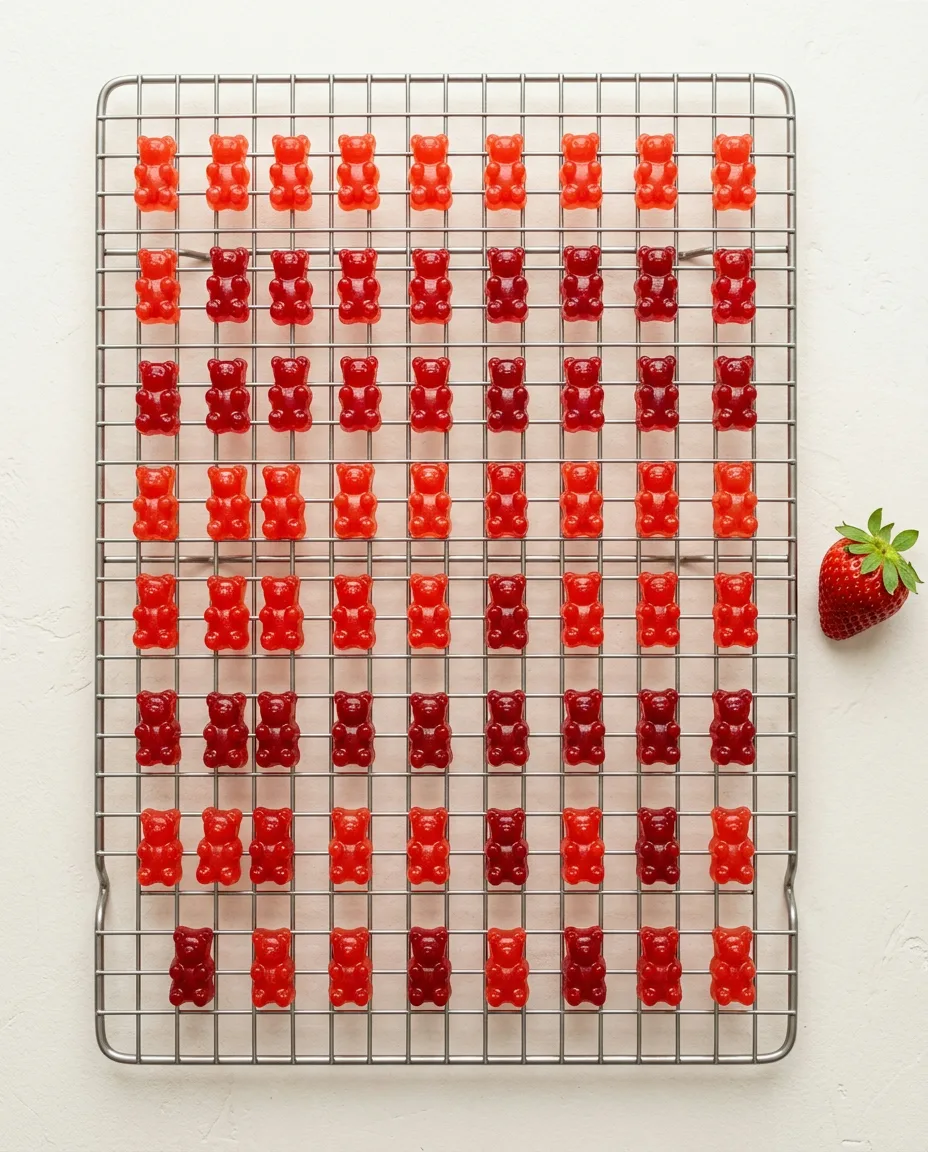
Space the bears out on a wire rack so air reaches every face. Leave them at room temperature for 24 to 72 hours, turning them once a day so the flat underside dries at the same rate as the rounded top. Weigh a handful at the start, then weigh that same handful each morning. You want about a 20 percent loss, which is roughly where the bite goes from soft to springy.

Not the fridge. A fridge is a humid box, and bears left in one stay wet and turn sticky instead of firming up. A kitchen sitting above about 60 percent humidity stalls them the same way, and after three days you have the soft bear you started with. A small fan pointed across the rack fixes it. So does an oven switched off with only the light on and the door propped a finger’s width.

Cured bears keep their faces. Uncured ones slump over a few hours on the counter and the moulded detail rounds away, which is most of why shop bears look sharp and homemade ones often do not.

Red strawberry gummy bears spaced apart in rows on a stainless steel wire cooling rackSave

Swaps, with the numbers attached

Gelatin and agar are not swaps for each other. Pectin is not a swap for either. Changing the base without changing the quantity gives you soup or a rubber tile, so here are the numbers that actually work.

Agar, for a vegan batch. Reduce the purée to 200 g instead of 150 g, add 40 g of water, and drop the 90 g soaking step, since agar hydrates in the purée itself. Use 5 g of agar powder for that 240 g of liquid. Agar has to reach a full rolling boil for two minutes or it will not hydrate at all, which is the opposite of how gelatin behaves. It then sets at around 40°C, warm enough that it can set in the pan while you are still filling the mould, so work fast. The texture breaks clean instead of stretching. Cure these for 24 hours and no longer, because agar keeps drying until it goes glassy.

Pectin. High-methoxy pectin, the type sold for jam, needs acid and a great deal of sugar. It wants something near 60 percent sugar by weight to gel, which in this batch means over 200 g of sugar in place of 45 g. That is a workable sweet in its own right. It is also a different recipe, and it belongs in a different article.

Less sugar. You can take the 45 g down to 25 g. Below that the bears cure leathery and the flavour flattens out, because some of that sugar is holding water in the finished bear and slowing the drying down.

Honey for the glucose syrup. Same 25 g. Honey browns faster under heat, so stir it in during the last five minutes of the reduction rather than at the start.

Sour finish. 1 g of citric acid, stirred in with the lemon juice. Do not roll cured bears in a sugar-and-acid coating unless you plan to eat them that week. Acid pulls moisture out of the surface and the coating turns to syrup in the tub.

When a batch goes wrong

  • Still liquid after an hour in the fridge. Either the purée went back on the heat after the gelatin joined it, or the gelatin was short. Warm the mix to 55°C, stir in another 5 g of gelatin soaked in 20 g of water, and refill the mould.
  • Sticky and wet after two days on the rack. Humidity, almost every time. Move the rack in front of a fan.
  • Cloudy white streaks running through the bear. Foam stirred back in. Skim harder next time, because nothing rescues it once it has set.
  • Brick-coloured rather than red. The reduction ran too long or too hot. Wider pan, higher heat, less time.
  • Rounded bears with no faces. Demoulded too early, or never cured.
  • A skin forming on the purée while it cools. Press cling film onto the surface during the wait down to 60°C.

How long they actually keep

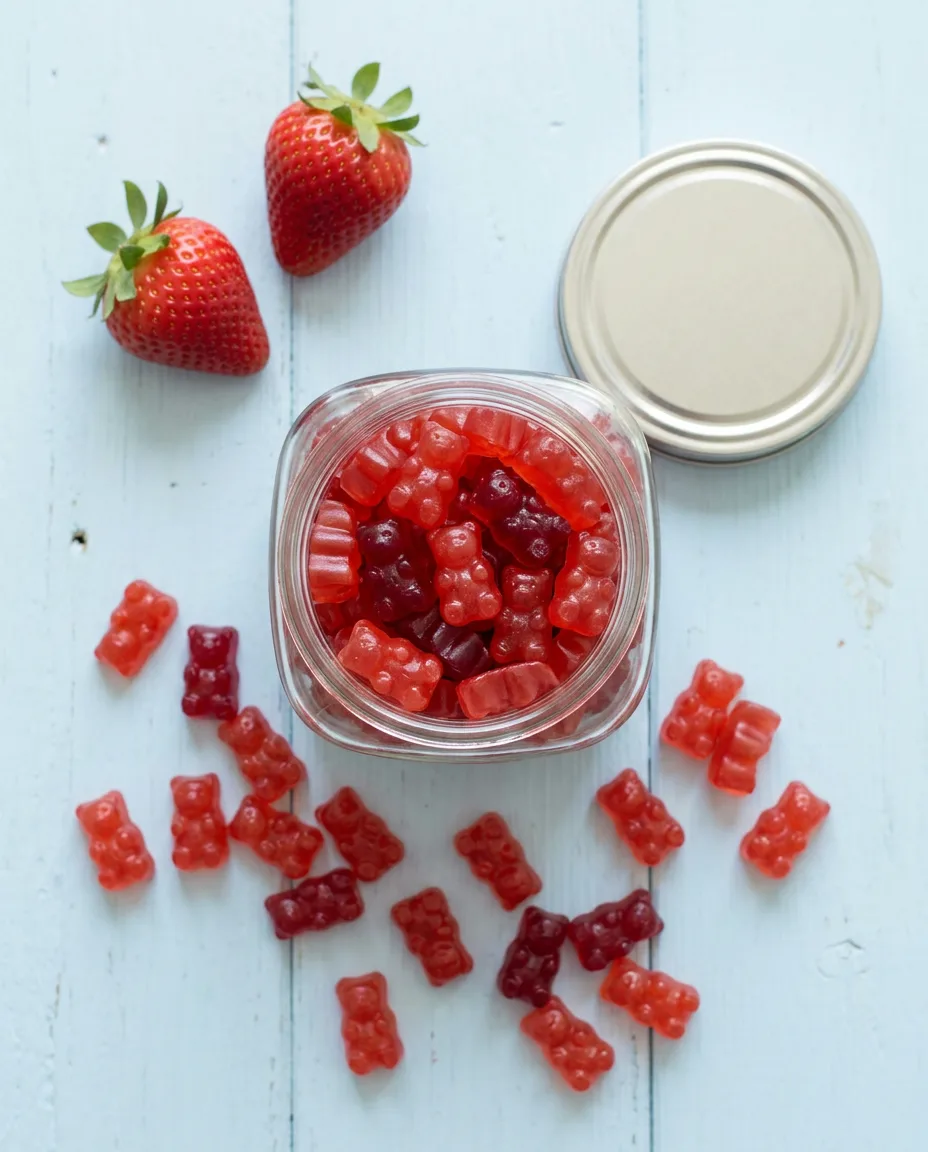
Airtight in the fridge, about two weeks. In a sealed jar on the counter, four or five days before they soften and start to bead moisture. There is no preservative in these and nothing controlling how much water is left inside them, so they are a fridge product. The two-week figure is honest rather than cautious.

Freezing works in the sense that they survive it. The surface goes wet on thawing and the springy bite never fully comes back. A folded paper towel in the tub soaks up the sweat and buys a few extra days either way. Anything fuzzy means the whole batch goes out, because mould visible on one bear has already spread spores across the rest.

A squat glass jar packed with red strawberry gummy bears on a pale blue wooden surfaceSave